Core
Proof
- Facts
- Evidence
- Timestamps
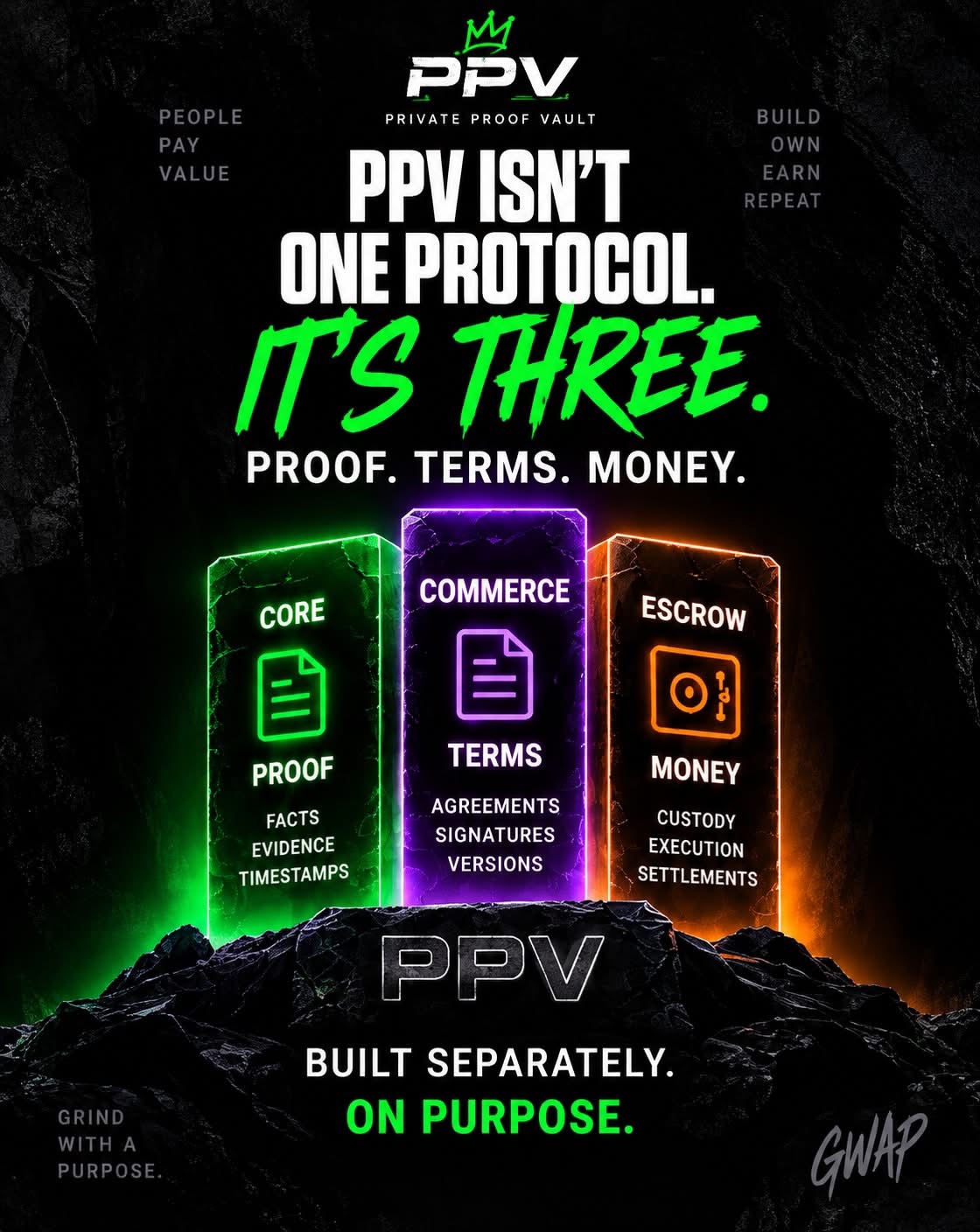
What actually happened — locked in, in order, so nobody can rewrite it later.
Most deals break because the facts, the agreement, and the money all live in the same messy place — chats, screenshots, and trust. PPV splits them into three separate systems that check each other. That separation is the product.
What actually happened — locked in, in order, so nobody can rewrite it later.
What everybody agreed to — signed, versioned, and impossible to quietly edit.
Where the money sits and when it moves — only when Proof and Terms say so.
PPV is Private Proof Vault — a vault for the record of a deal, not just the money in it. The letters carry the rest of the philosophy too. If you remember nothing else, remember this: proof comes before payment.
Private by default. Proof before claims. A vault — meaning the record is sealed, ordered, and built to be checked later, not just stored.
The left side of the poster. Money should follow real value between real people — not hype, not pressure, not a screenshot and a promise.
The right side of the poster. Do the work, own the record of it, earn from it, then run it again. PPV is the infrastructure under that loop.
Each pillar has one job and hard edges. The limits matter as much as the features: a pillar that can do everything can also break everything.
One giant system that holds the evidence, writes the contract, and controls the money is a single point of failure — and a single point of temptation. PPV splits the power so each part has to answer to the other two.
If the system holding the money could also edit the evidence, a dispute would be unwinnable. Proof lives apart, so the record of what happened can’t be adjusted to fit who’s holding the funds.
Terms are signed and versioned in Commerce. When the deal changes, it becomes a new version — the old one stays readable. Nobody “remembers” a different price, deadline, or deliverable.
Escrow doesn’t release funds because someone asked nicely. It executes against Terms, checked against Proof. Custody, execution, and settlement stay mechanical — on purpose.
A counterparty deal, end to end. Step through it — notice that money moves last, and only after the other two pillars agree.
In dark mode the pillar names glow green, purple, and orange — same as the monoliths on the poster.
No — PPV is in development inside the GWAP ecosystem, including PPV Commerce work in devnet mode with a counterparty inbox. This page explains the architecture and the thinking. It is not a launch announcement, and there is nothing to buy, connect, or deposit here.
Neither, as described on the poster. PPV is a structure for deals: a proof layer (Core), a terms layer (Commerce), and a money layer (Escrow). Wallets and payment rails plug into the Escrow side — they aren’t the vault itself.
Any deal where two sides don’t fully trust each other yet and the stakes are real: commissioned work, private sales, milestone-based projects, collaborations — anywhere “he said / she said” plus money on the line is the current system.
The record of your deal is yours. Proof doesn’t have to mean public. The vault is built so a deal can be verified by the people who need to verify it — without broadcasting the deal to everyone else.